
Between Meals Cookbook by Dani Fisher and Lauren Markham
Read some sample recipe-stories from the Between Meals cookbook, a project of Refugee Transitions.
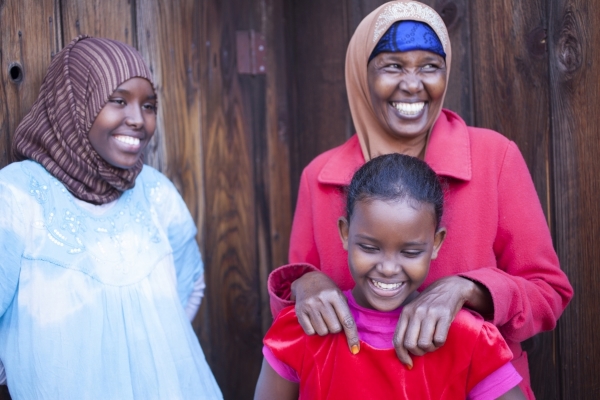
Malawah: A Sweet Flatbread from Somalia
"We ate malawah every morning in Dadaab," says Halimo, as she stirs floor and sugar in her sunlit East Oakland kitchen. Dadaab, the largest refugee camp in the world and home to over two hundred thousand Somali refugees like Halimo, is where she lived for 21 years before resettling to Oakland in 2011 with her three daughters.
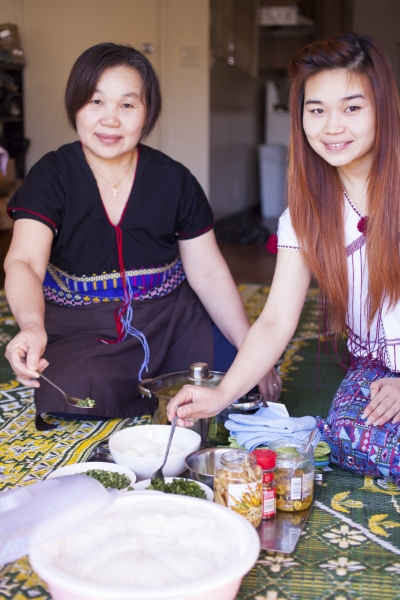
Kaw Swep Yo: Coconut Chicken Soup from Karen State, Burma
Naw Htoo ran a stand in the center of the Mae La refugee camp in Thailand, where she sold meals to other refugees and aid workers. With a small charcoal stove beneath a shaded booth, Naw Htoo cooked for dozens of people every day--and then went home to feed her family. "A lot of people really loved her food," says her 21-year-old daughter, Cho Mai. Naw Htoo's kaw swep yo was particularly popular.
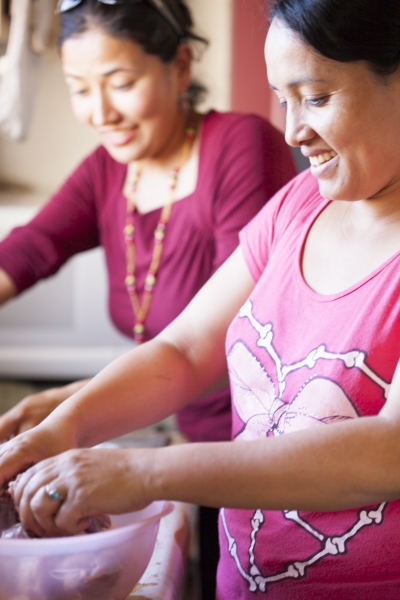
Goat Curry from Bhutan/Nepal
To find Devi's apartment among the labyrinth of buildings off Coolidge Avenue in East Oakland, it's best to just close your eyes and follow your nose, as smells of caramelized onions mixing with meat and turmeric beckon from the second floor. Inside, a Bollywood movie sings from the television, and Devi chops garlic to make goat curry--one of her family's treasured dishes and a favorite of her volunteer tutor, Lupe.
About Between Meals
An innovative narrative cookbook by Dani Fisher and Lauren Markham, Between Meals shares the expertise, recipes and stories of newly arrived refugee women in the Bay Area. This book documents traditional recipes from around the world--from Burma to Liberia to Afghanistan--from Refugee Transitions' participants, written down with the help of their Refugee Transitions tutors. Between Meals tells the stories of students' exile from their home countries, their journeys to the United States, and their efforts--literally and metaphorically--to nourish their families in their new California homes. Our goal was to give voice to these women's stories, giving them the professional treatment that they deserve as expert cooks with deep culinary wisdom.
As the primary caregivers, newcomer women provide nourishment—literally, of course, but also spiritually and emotionally—to their families. Food is a central means of nourishment and one aspect of life that women (wives, mothers, grandmothers, daughters) often manage. As refugee families resettle in the U.S. and adapt to a strange new environment, food is one of the primary mainstays—like a connective tissue back to their homelands. Yet, food is also a vehicle of assimilation, navigating sinuous roads of acculturation.
While immigrant women in Refugee Transitions’ study program take immense pride in their cooking, they don’t always see it as a skill that is relevant outside their home—let alone as a significant contribution to the development of California’s celebrated cuisine and food culture. Between Meals gives a platform and audience for their skill, thus affirming their relevance in their new homes and offering a chance to share their knowledge from a place of expertise and command. Local chefs and food writers get credit for their contributions to California culture all the time. This project will give credit to the women who carry and safeguard skills and knowledge over journeys both small and large.
About the authors:
Dani Fisher has styled and art directed for outlets such as Ten Speed Press, Chronicle Books, Wiley, Random House and Food and Wine and for nationally acclaimed chefs such as Bryant Terry, Nancy Silverton and Top Chef Master Susan Feniger. A former editor at Food and Wine, she regularly contributes recipes to various publications, including DesignSponge and Martha Stewart Living. Her love and approach to cooking has been greatly influenced by her experience chefing in a rural Italian restaurant and the traditional Jewish recipes passed down from her grandmother.
Lauren Markham is a writer, educator and proud former employee of Refugee Transitions. She writes articles and essays focusing on youth and migration, and her work has been featured in This American Life, Orion, Guernica, VQR, The Oxford Journal of Forced Migration, among others. Lauren serves as Community Programs Manager at Oakland International High School, where she oversees supportive services for Bay Area’s immigrant youth and families. After years spent visiting the homes of her students and their families, she is thrilled to celebrate and document the culinary expertise of so many refugee women.
This project was made possible with support from Cal Humanities, an independent nonprofit state partner of the National Endowment for the Humanities. For more information, visit www.calhum.org.